Chapter 22: QUAIL RUN - Sustainability
Updated: Mar 29

Mindfully caring for the earth is the most important part of our farming philosophy at the Keating Vineyard in Sonoma.
How do we do that? It all begins with our love of nature. It continues as we strive to protect it. Sustainability is the key.
Let’s define sustainability! ChatGPT defines "sustainability" as:
Sustainability is meeting present needs without compromising future generations' ability to meet theirs, balancing environmental, economic, and social pillars. Key principles include conservation of finite resources, long-term thinking, and ecological harmony. It uses techniques that emulate nature—such as reduced tillage, cover cropping, and biodiversity—to improve soil health, conserve water, and reduce pollution.
The Keating Family Vineyard has been nurtured from the ground up transforming a native field into a beautiful vineyard estate. It officially qualifies as a sustainable vineyard in Sonoma County. Our legacy is intended to provide for years to come. What does that mean in vineyard terms?

We are proud to express our commitment to sustainability in farming practices. “Sustainability is a holistic, adaptable approach aimed at continuous improvement.” To truly be sustainable, farming practices are in tune with the natural environment and the goal is to nurture the land in organic ways in order to steward the continued success of farming crops and fertile growing conditions.
From the beginning, we have been strict about how the vineyard is cultivated. The initial soil samples indicated that a crop of fava beans would prepare the earth for planting the rootstock. It was then turned under to compost naturally and the disease resistant rootstock was planted.
Our controlled irrigation has been delivered by drip emitters using water sparsely. Initially, irrigation was needed more to establish deep roots when planted in 2016 during the extended drought years. Our ultimate goal is to become “dry farmed” which means that no irrigation is used whatsoever. Each year, less and less water is used as the vines become more robust and their long roots more established. Winter rains provide the necessary water to the ground that roots find deep below, and vines are meant to struggle during the growing season to produce a fruit that is complex, and rich in flavor and color. In California, unlike Europe, most vineyards do need to irrigate to some degree because water is already sparse in California, Farmers need to be conscious and conserve water where possible. We lean toward conservation and give the vines the least possible amount of water needed.

Each fall after harvest, a cover crop is planted between the rows of vines. It creates biodiversity and offers nutrients to replenish the soil. The cover crop acts as a habitat for beneficial insects, pollinators, and birds, while fostering a diverse soil microbiome, increasing earthworms, and reducing reliance on herbicides. While the pruned vines rest, cover crop flowers bloom and each spring this cover crop is gently turned under. Crops such as fava beans, and flowering daikon radish mixed with calendula, have been used the past few years to sustain the vineyard earth. When conditions such as unexpected rain occur during the growing season, it is necessary to spray the vines but only using organic herbicidal solutions.

We care about the quality of fruit as much as protecting the growing environment. We follow the needs and look to nature as our guide. Our farmers at Nunez Vineyard Management are amazing and they have been our farming team for ten years running. We celebrate with them each year at Harvest Time with food and wine.
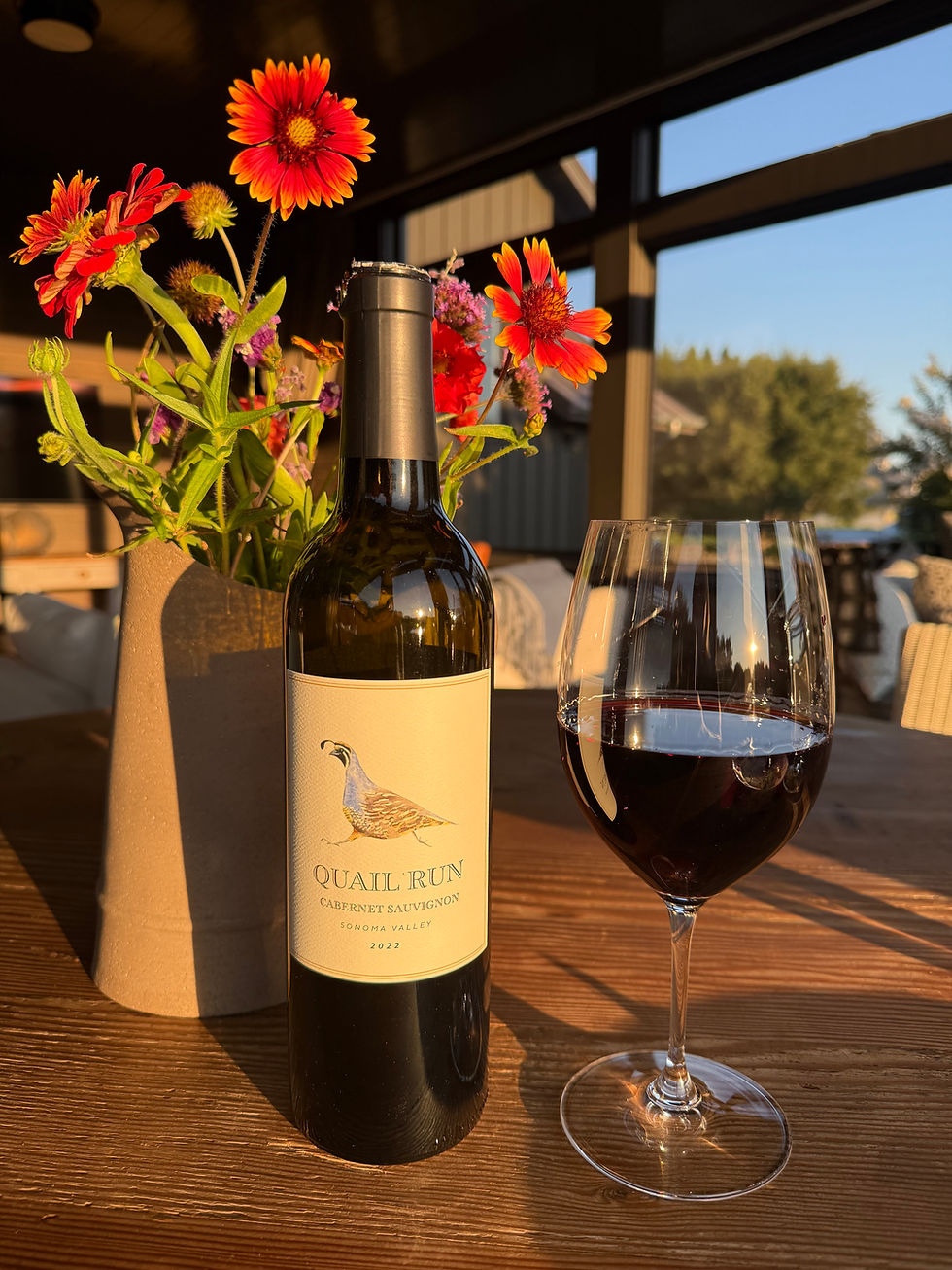
QUAIL RUN Cabernet is a single vineyard estate wine that is produced with such care and quality control. In today’s world where small family vineyards are being bought out by large corporations, it is becoming more rare to find such a truly exceptional wine as QUAIL RUN, that is grown and produced in limited quantities.
Knowing that it is so carefully crafted, it’s no wonder our wine club is growing by word of mouth alone! Join now before it’s too late. Our limited production is keeping the wine exclusive and very desirable.




Comments